Sustainable Development approach
In alignment with the United Nations’ 17 Sustainable Development Goals and the Vietnamese Government’s commitment to achieving net-zero carbon emissions by 2050, as announced at COP26, the School integrates environmental, social, and governance (ESG) considerations across its core activities. Sustainability principles guide the School’s day-to-day operations, educational programs, research, and investment decisions, with particular attention paid to biodiversity protection, climate change, the development of sustainable businesses, and other non-traditional security challenges, while promoting the health and well-being of students, academic staff, and the wider community.
At the same time, the School upholds academic freedom as a fundamental principle underpinning sustainable and responsible scholarship. Academic staff are entitled to exercise their professional judgment, pursue research of their choosing, and express scholarly views without fear of retaliation or adverse employment consequences. This commitment ensures that sustainability-related research and teaching are conducted with intellectual independence, integrity, and rigor, allowing evidence, expertise, and inquiry to guide academic work and the dissemination of research outcomes.
Purpose
This Policy was developed to ensure that our academic and research activities match the priorities, values and strategy of Hanoi School of Business and Management, Vietnam National University, Hanoi.
Legal Basis
The Academic and Research Freedom Policy of HSB is developed in accordance with the laws and policies of Viet Nam, including the Law on Higher Education 2025, dated 10th December 2025 (Law No. 125/2025/QH15) and Resolution No. 57-NQ/TW, dated 22nd December 2024, on breakthroughs in the development of science, technology, innovation, and national digital transformation. This Policy is also aligned with HSB’s mission, vision, and core values, which emphasize academic excellence, intellectual independence, innovation, and responsible contribution to society.
Principles
Integration of ESG Factors
Environmental, social, and governance (ESG) considerations are systematically integrated into investment analysis, decision-making, and risk assessment alongside financial performance.
Integration of Non-Traditional Security Factors
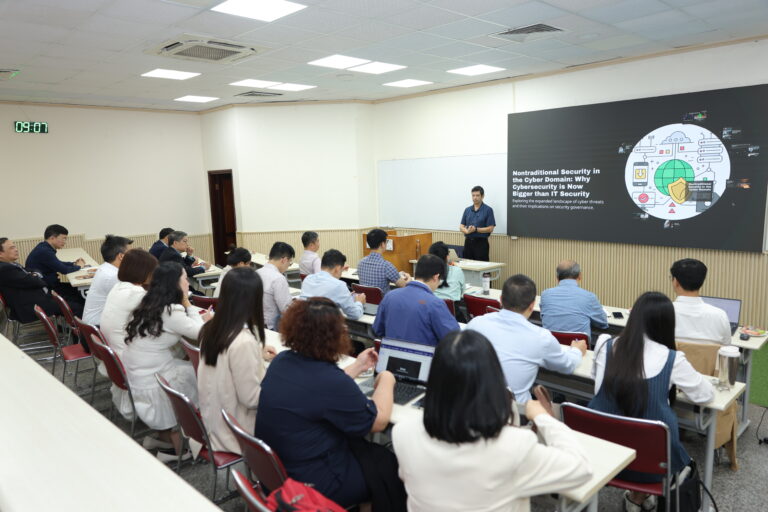
Academic and research activities consider non-traditional security risks, including climate change, public health, cybersecurity, food security, water security, health security…, and prioritize initiatives that enhance resilience, reduce systemic risks, and support sustainable development.
Long-Term Value Creation
Investment decisions prioritize long-term economic, environmental, and social value rather than short-term financial gains, supporting sustainable growth and resilience.
Ethical and Responsible Conduct
Investments align with high ethical standards, avoiding activities that cause significant harm to society, human rights, or the environment.
Transparency and Accountability
Investment policies, criteria, and outcomes are clearly communicated to stakeholders, ensuring accountability and responsible governance.
Active Ownership and Engagement
Where applicable, the School encourages active engagement with invested organizations to promote responsible business practices and sustainability improvements.
Risk Management and Resilience
Sustainability-related risks, nontraditional security related risks, including climate, regulatory, and reputational risks, are identified and managed to protect long-term institutional value.
Educational Alignment
Investment practices support the School’s mission in teaching, research, and knowledge creation, serving as a living laboratory for sustainable education.
Continuous Improvement
The School regularly reviews and updates its Academic and Research approach to reflect evolving sustainability standards, research insights, and stakeholder expectations.
Policy
The School affirms the academic and research freedom of its students and academic staff to pursue teaching, research, and innovation in the fields of integrated business management and management of non-traditional security. In support of this freedom, the School provides an enabling environment through appropriate research funding, infrastructure, capacity-building and training activities, and innovation-oriented support mechanisms. This includes encouraging interdisciplinary research, student-led initiatives, startups, and practical learning platforms that facilitate the application of research outcomes to real-world challenges, contributing to innovation, sustainable development, and societal resilience.
Academic and research freedom is exercised within a framework of professional responsibility and ethical standards. The School does not support academic or research activities that conflict with its mission, core values, or sustainability commitments, including those that cause significant environmental harm, violate human rights or applicable laws, undermine social responsibility, or lack clear scholarly or societal value. Activities that are non-transparent, speculative, or inconsistent with responsible governance and long-term development objectives are likewise excluded.
Implementation and Responsibility
The Deans of faculties, Heads of Undergraduate Program Management Office (UPMO), Postgraduate Program Manage Office (POMO) and the Science, Technology and Development Cooperation Office are responsible for ensuring the Academic and Research activities implemented on HSB’s behalf align with this policy.
Approved in December 2025